
As an Amazon Associate I earn from qualifying purchases. Affiliate disclosure.
As an Amazon Associate I earn from qualifying purchases. Affiliate disclosure.
Beef tallow is rendered beef fat, and for seed-oil-free cooking it does the jobs canola and soybean oil usually do: deep frying, roasting and searing. This guide merges our two tallow buying guides into one, with the products re-checked against live Amazon listings and the nutrition and smoke-point numbers sourced.
Quick answer: pick a tallow that lists one ingredient (beef tallow or beef suet), comes in glass, and suits how much you cook. Fatworks Grass Fed & Finished Beef Tallow for grass-fed sourcing, or South Chicago Packing Wagyu Beef Tallow (42 oz) for frying volume.
How we chose
This is a desk-researched comparison, not a lab test. We shortlisted products with a current, verified Amazon listing and compared what can be checked: the ingredient list, what the maker states about sourcing and processing, the package, and how each fat fits the cooking jobs on this site. Sourcing and quality claims below are the manufacturers’ own unless a study is cited. We list no prices because they change daily.
The picks

1. Fatworks Grass Fed & Finished Beef Tallow — Best grass-fed
- Maker states: 100% grass-fed, grass-finished beef suet from U.S. family ranches
- Glass jars, no preservatives listed
- Current Amazon listing is a pack of three 14 oz jars
Good for: roast potatoes, searing, shallow and deep frying, seasoning cast iron
Grass-fed claims are Fatworks’ own; we have not audited the supply chain.
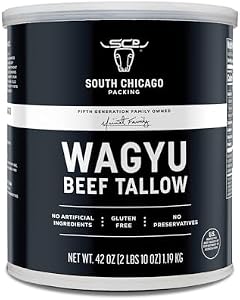
2. South Chicago Packing 100% Pure Wagyu Beef Tallow, 42 oz — Best for frying volume
- Single large 42 oz jar of Wagyu beef tallow
- The listing does not claim grass-fed sourcing
- A big jar suits deep frying, where you need a full pot of fat
Good for: French fries, fried chicken, smash burgers
Or render your own
If you have a butcher nearby, raw suet is the cheapest route to tallow and you control every step. Follow How to Render Tallow and see the equipment we list for rendering.
Tallow next to the other traditional fats
| Fat | Smoke point (typical) | Saturated | Monounsaturated | Polyunsaturated (linoleic) |
|---|---|---|---|---|
| Beef tallow | 230 °C / 446 °F [1] | 50% | 42% | 4% (3%) |
| Lard | 240 °C / 464 °F [1] | 39% | 45% | 11% (10%) |
| Ghee | about 250 °C / 482 °F [2] | 62% | 29% | 4% (2%) |
| Avocado oil (refined) | above 250 °C / 482 °F [3] | 12% | 71% | 14% (13%) |
| For comparison: soybean oil | — | 16% | 23% | 58% (51%) |
Fatty-acid shares are USDA FoodData Central values per 100 g, rounded [4–8]. Smoke points vary with refining and freshness; treat them as typical values, not guarantees.
What to look for on the label
- One ingredient. Beef tallow or beef suet. Some tallow blends add other fats, so read the list.
- Rendered from suet if you want the mildest flavour; trim fat tastes beefier.
- Glass jar and a best-by date. Animal fats still go rancid; keep the jar sealed, away from heat, and refrigerate it if you use it slowly.
- Sourcing claims you can check, such as grass-fed or organic certification on the label itself.
How to use it
Tallow is solid at room temperature and melts quickly in a hot pan. Use it where you want a crisp crust: tallow roast potatoes, tallow French fries, smash burgers and Southern fried chicken. For the bigger picture see What Is Tallow?, Lard vs Tallow and our new frying fats comparison.
Part of the Traditional Fats Guide.
Want the short list? Everything we recommend across the site is on one page: our seed-oil-free pantry and cookware picks.
Our picks compared
| Our pick | Fat type | Smoke point (source) | Best for | Size |
|---|---|---|---|---|
| Fatworks Grass Fed & Finished Beef Tallow | Beef tallow (rendered beef fat) | 230 °C / 446 °F [1] | Searing, deep frying, roast potatoes | 14 oz jars, 3-pack |
| Fatworks Pasture Raised Leaf Lard | Leaf lard (rendered pork fat) | 240 °C / 464 °F [1] | Pie crust and pastry, frying, Mexican and Chinese cooking | 14 oz |
| Pure Indian Foods Organic Grassfed Ghee | Ghee (clarified butter) | about 250 °C / 482 °F [2] | Indian cooking, blooming spices, high-heat sautéing | 14 oz |
| Red Palm Oil (100% Pure) | Red palm oil (unrefined palm fruit oil) | No figure in our sources | West African stews and sauces | 33.81 oz |
| Atlas Organic Extra Virgin Olive Oil | Extra virgin olive oil | about 207 °C / 404 °F [3] | Dressings, finishing, everyday sautéing | 1 L |
| Nutiva Organic Coconut Oil | Coconut oil | about 191 °C / 376 °F [3] | Southeast Asian curries, baking | 29 fl oz |
| Chosen Foods Refined Avocado Oil | Avocado oil (refined) | above 250 °C / 482 °F [4] | Neutral high-heat cooking, homemade mayo | 1 L |
Smoke points are typical lab values for the fat type, not for these exact jars, and vary with refining and freshness. Smoke point alone does not predict how a fat holds up to heat [3]. Sizes are as listed on Amazon. Affiliate links: as an Amazon Associate we earn from qualifying purchases.
Frequently asked questions
What is the best beef tallow for cooking?
For everyday frying and roasting, a single-ingredient tallow rendered from suet, in a glass jar, is the safest bet. Fatworks Grass Fed & Finished meets all three on its listing. For big-batch frying, South Chicago Packing’s 42 oz Wagyu tallow is the larger, more economical jar.
What is the smoke point of beef tallow?
The Institute of Shortening and Edible Oils lists 230 °C (446 °F) for commercial, deodorized tallow. Home-rendered tallow can smoke lower, because smoke point drops as free fatty acids rise.
Is grass-fed tallow different from regular tallow?
Studies of grass-fed beef find more CLA, omega-3 fats and beta-carotene in the fat than in grain-fed beef (Daley et al., 2010). The amounts are small, and they say nothing about cooking performance; the deeper yellow colour comes from beta-carotene.
Can I render my own tallow?
Yes. Raw suet from a butcher renders down in a few hours on low heat. Our step-by-step guide is How to Render Tallow.
Sources
- Institute of Shortening and Edible Oils: Typical smoke, flash and fire points of commercially available fats and oils — lard 240 °C (464 °F), tallow 230 °C (446 °F); deodorized commercial samples, single test each
- Health benefits of ghee: review of Ayurveda and modern science perspectives, J Ayurveda Integr Med (2024) — ghee smoke point about 250 °C; ghee contains short-chain fatty acids including butyric acid, and CLA
- Determining the Arrhenius kinetics of avocado oil: oxidative stability under Rancimat test conditions, Foods (2019) — avocado oil smoke point above 250 °C
- USDA FoodData Central: Fat, beef tallow (SR Legacy 171400)
- USDA FoodData Central: Lard (SR Legacy 171401) — fatty acid profile per 100 g
- USDA FoodData Central: Butter oil, anhydrous (ghee) (SR Legacy 173412)
- USDA FoodData Central: Oil, avocado (SR Legacy 173573)
- USDA FoodData Central: Oil, soybean, salad or cooking (SR Legacy 171411) — linoleic acid about 51 g per 100 g
- Daley CA et al. A review of fatty acid profiles and antioxidant content in grass-fed and grain-fed beef. Nutr J (2010) — grass-fed beef fat is higher in CLA, omega-3s and beta-carotene
Want more recipes like this in one place? browse Savannah's seed-oil-free cookbooks in our shop.
African, Hawaiian, Indian, Mediterranean, Asian, Exotic, Chicken, Rice, Cookies, Coffee, Spices, Plants, World Cuisine, 30-Minute Dinners and more.
View All Books on Amazon →