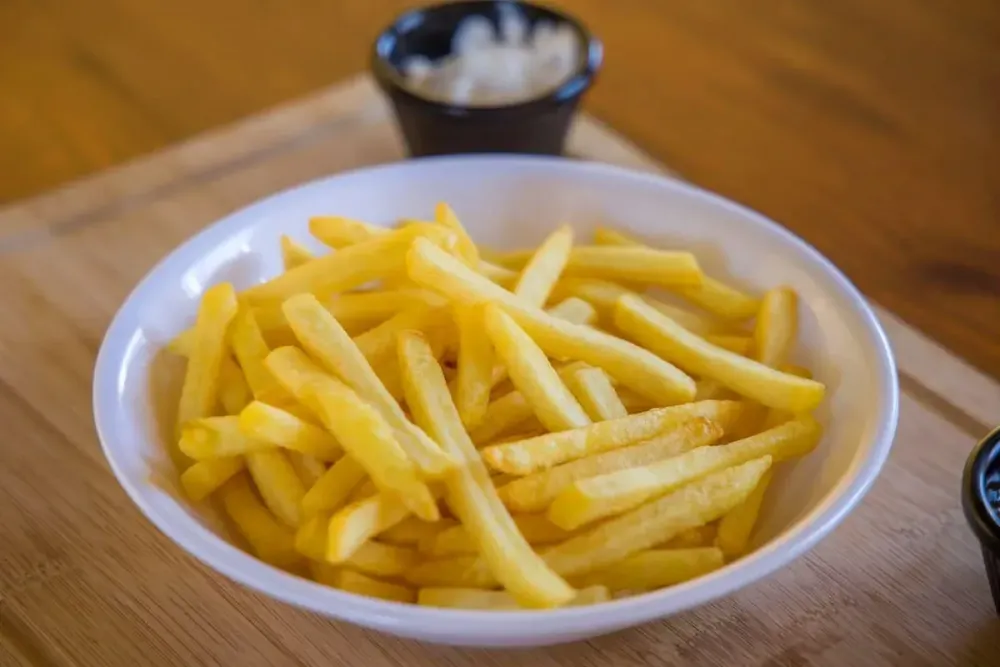
McDonald's used to fry everything in beef tallow — french fries, apple pies, chicken nuggets, fish fillets. Until 1990, the entire fry line ran on rendered beef fat. The switch to vegetable oil is now well-documented and the flavour difference is equally well-remembered. This is the story of that switch, why it happened, and what it tells us about the politics of fat and food.
The McDonald's Tallow Era
From McDonald's founding through 1990, the frying fat was 93% beef tallow and 7% cottonseed oil. The tallow came from the beef supply chain — rendered kidney and loin fat that was a byproduct of the beef processing that supplied the burger patties. The fries tasted the way they did — the flavour that people still describe in particular terms decades later — because of that fat.
The Phil Sokolof Campaign
In 1986, Phil Sokolof — a Nebraskan businessman who had survived a heart attack and become convinced that saturated fat was the cause — began running full-page newspaper advertisements targeting McDonald's, Wendy's, and Burger King for cooking in beef tallow. His 1988 advertisement titled 'The Poisoning of America' ran in 40 newspapers. McDonald's announced in 1990 that it would switch to 100% vegetable oil. The irony of the switch was that the vegetable oil replacement — partially hydrogenated soybean oil — contained trans fats that were subsequently found to be more harmful to cardiovascular health than the saturated fat it replaced.
The Flavour After the Switch
McDonald's added 'natural beef flavour' to its french fry recipe after switching to vegetable oil — an explicit acknowledgement that the tallow's flavour could not be replicated by a neutral fat alone. The current McDonald's fry formulation includes: potatoes, vegetable oil (canola, corn, soybean, and hydrogenated soybean oils), natural beef flavour (which contains wheat and milk derivatives in the US), dextrose, sodium acid pyrophosphate, and salt. The original was: potatoes, beef tallow, salt.
Making the Original at Home
Tallow-fried fries are not nostalgia — they are the original, and the original was better. Russet potatoes, par-fried at 160°C, frozen to rupture the cells, then fried at 185°C in beef tallow. The result is a french fry of quality that has not been available commercially in the US since 1990.
Does McDonald's use any tallow today?
No — McDonald's uses refined vegetable oil in all markets globally.
Why did the switch happen?
Public pressure campaign by nutrition activist Phil Sokolof, combined with growing institutional consensus against saturated fat in the late 1980s.
Did the flavour actually change?
Consumer taste tests at the time showed measurable preference for the tallow version. McDonald's own addition of 'natural beef flavour' to compensate suggests the company knew the switch reduced quality.
Follow Savannah: @theefoodiekitchen · Facebook · All Links
Key Points on McDonald's original tallow frying
- McDonald's switched in 1990 — Changed from beef tallow to vegetable shortening under pressure from the Center for Science in the Public Interest. Phil Sokolof ran full-page newspaper ads attacking McDonald's for using beef fat. The fries immediately changed.
- The flavour came from tallow — The specific flavour compound was 2-methyl-2-butenal — a Maillard reaction byproduct produced by beef tallow at frying temperature. Canola and soybean oil produce different, less complex Maillard compounds.
- Tallow fries can be replicated at home — Russet potatoes, soaked in cold water, dried completely, fried twice in beef tallow (first 325°F for 5 minutes, then 375°F for 3 minutes), finished with fine sea salt.
Common Misconceptions About McDonald's original tallow frying
Most confusion around McDonald's original tallow frying comes from outdated dietary messaging. The research picture has shifted substantially since the 1960s but popular messaging has not kept pace. Fat composition, processing method, and cooking temperature all affect the actual outcome in ways that blanket claims ignore.
Did the switch make McDonald's fries healthier?
Not clearly. The switch added artificial beef flavouring and partially hydrogenated soybean oil — which contained trans fats. The reformulation that was meant to be healthier introduced the fat type most associated with cardiovascular disease.
Can I fry at home in beef tallow?
Yes. SCP Wagyu Tallow and Fatworks are widely available. 420°F smoke point makes it excellent for deep frying. Tallow can be strained and reused multiple times — more stable than seed oil for repeated high-heat use.
African, Hawaiian, Indian, Mediterranean, Asian, Exotic, Chicken, Rice, Cookies, Coffee, Spices, Plants, World Cuisine, 30-Minute Dinners and more.
View All 23 Books on Amazon →