
As an Amazon Associate I earn from qualifying purchases. Affiliate disclosure.
An air fryer doesn't need much fat, but it does need the right fat. That thin coat is what turns a pale potato golden and makes chicken skin crackle, and most air fryer advice tells you to reach for vegetable oil or a can of spray. You don't need either. Every air fryer job can be done with butter, ghee, tallow, lard, coconut oil, olive oil or avocado oil, as long as you match the fat to the temperature. This guide shows you how to do that.
If you're new to the reasoning, our guide to the eight common seed oils covers what we leave out and why. This post is about what goes in instead.
How hot does an air fryer get?
The USDA Food Safety and Inspection Service describes air fryers as "essentially countertop convection ovens". A heating element and a fan blow hot air around the food, and the FSIS says most foods need 5 to 25 minutes at 350–400 °F. That range is the number to plan around. Whatever fat you choose will sit on the surface of the food in a stream of air at that temperature.
That's why smoke point matters here. Smoke point is the temperature at which a fat starts to break down and give off smoke (Nebraska Extension's definition). Push a fat past it and you get acrid smoke, bitter flavour and a sticky residue on the basket. The aim is simple: pick a fat whose published smoke point sits comfortably above the temperature you've set.
A word of caution about the figures: published smoke points vary from source to source because they depend on how refined the fat is, how fresh it is and how it's tested. Treat the numbers below as guides, not lab guarantees. Where good sources disagree, I've given the range. For the chemistry of how fats oxidise when heated, the AOCS Lipid Library is the reference to read.
Seed-oil-free fats for the air fryer, compared
| Fat | Published smoke point | Flavour | Best air fryer jobs |
|---|---|---|---|
| Refined avocado oil | 520 °F (CSU; Wisconsin Extension) | Neutral | Anything at 400 °F: thin fries, crisping, reheating |
| Ghee | 375–485 °F (CSU, depending on purity); about 250 °C / 482 °F (Frontiers review) | Buttery, nutty | Spiced chicken, cauliflower, paneer, anything you want to taste of butter |
| Beef tallow | 400 °F (Nebraska Extension) | Mild, savoury, beefy | Chips and fries, roast potatoes, wings, onion rings |
| Lard | 370 °F (CSU) | Very mild, porky | Pork, potatoes, hand pies and pastry at 350–360 °F |
| Refined (light) olive oil | 390–470 °F (CSU); 465 °F (Wisconsin Extension) | Mild | Vegetables and fish at 375–390 °F |
| Extra virgin olive oil | 325–375 °F (Wisconsin Extension); 350 °F (CSU) | Fruity, peppery | Vegetables at 350 °F or lower, or tossed on after cooking |
| Coconut oil | 350 °F (CSU) | Coconut (virgin); mild (refined) | Coconut shrimp, sweet potato, bakes at 325–350 °F |
| Butter | 300 °F (Nebraska Extension); 350 °F (CSU) | Rich, creamy | Brushing on in the last minutes, crumb toppings, low-temperature bakes |
Figures as published by the sources listed at the end of this post. For a wider look at every fat, see our cooking fat smoke points guide.
Which fat for which job, and why
Refined avocado oil: the 400 °F workhorse
If you keep only one bottle by the air fryer, make it refined avocado oil. Its published smoke point of about 520 °F leaves a big margin above the hottest air fryer setting, and its flavour is neutral, so it won't fight with your seasoning. That makes it the safe choice for thin fries, frozen-style snacks and anything you crisp at full whack. Make sure the label says refined: Wisconsin Extension lists virgin avocado oil at just 375 °F. And no, avocado oil isn't a seed oil, because it's pressed from the fruit's flesh. Our post Is Avocado Oil a Seed Oil? explains the distinction.
Ghee: butter flavour that survives the heat
Whole butter is the fat everyone wants on their air fryer food, and the one most likely to scorch. Ghee solves that. It's butter with the water and milk solids removed, and the sources put its smoke point well above butter's: 375–485 °F on Colorado State's chart, and about 250 °C (482 °F) in a 2026 review in Frontiers in Food Science and Technology. Use it for tandoori-style chicken, spiced cauliflower and potatoes when you want a buttery, nutty finish at 375–400 °F. More on the difference in Ghee vs Butter.
Beef tallow: the best-tasting chips
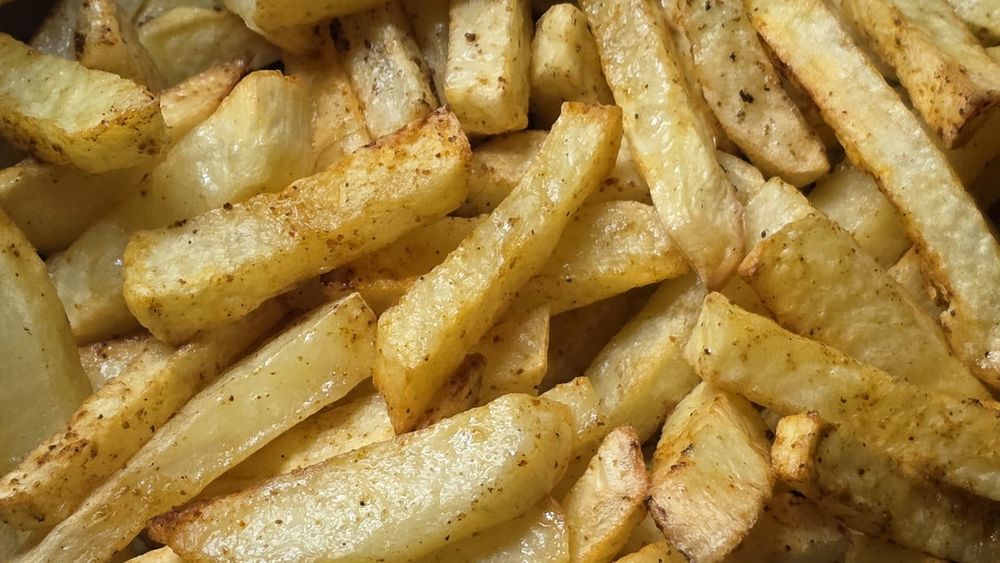
Tallow is my pick for chips, roast potatoes and wings. It's a traditional frying fat, and a light coat gives an air-fried potato that savoury, beefy depth that oil never will. Nebraska Extension lists its smoke point at 400 °F, which is the very top of the air fryer range. So run tallow jobs at 360–380 °F rather than flat out, and give them an extra few minutes. Tallow is solid at room temperature, so melt a spoonful and toss the food in it while it's warm. For the deep-fried version, see Tallow-Fried Fries at Home.
Lard: the quiet all-rounder
Lard tastes of very little, which is exactly why it's useful. At a published 370 °F, it suits pork chops, potato wedges and lard-pastry hand pies at 350–360 °F. If you're choosing between the two animal fats, our Lard vs Tallow comparison goes deeper.
Olive oil: know which bottle you're holding
Extra virgin olive oil has the most flavour and the lowest heat tolerance of the olive grades: 325–375 °F according to Wisconsin Extension, and 350 °F on Colorado State's chart. Use it for vegetables at 350 °F or below, or simply toss the cooked vegetables in it once they come out. Refined or "light" olive oil is far more forgiving, at 390–470 °F, and handles fish and vegetables at 375–390 °F.
Coconut oil and butter: lower settings and finishing
Coconut oil's published smoke point is 350 °F. Virgin coconut oil tastes distinctly of coconut, which is perfect for coconut shrimp or sweet potato and wrong for almost everything else. Butter sits lowest of all, at 300 °F (Nebraska) to 350 °F (Colorado State), and its milk solids burn first. Don't toss food in butter and blast it at 400 °F. Instead, cook in ghee, tallow or avocado oil, then brush on melted butter for the last two or three minutes, or use it in crumb toppings and lower-temperature bakes.
How to oil air fryer food without spray
Skip the aerosol can. As well as being an oil you can't choose, most nonstick cooking sprays contain soy lecithin, and the Cookware & Bakeware Alliance told Wirecutter that the sprays "start to congeal at a very low temperature, causing a sticky film to form" on nonstick surfaces, air fryer baskets included. Here's the better method:
- Melt a small amount of fat. A teaspoon or two per batch is usually enough to coat the food lightly. Solid fats like tallow, lard, ghee and coconut oil need a few seconds in a warm pan first.
- Toss the food, not the basket. Toss it in a bowl or on a rimmed sheet pan until every surface glistens. This coats the food evenly and leaves the basket clean.
- Don't overcrowd the basket. The FSIS warns that overcrowding stops the air circulating and can leave food undercooked. Cook in batches, and hold finished batches on the sheet pan.
- Shake or turn halfway through. Fresh surfaces get their turn in the hot air.
- Finish with flavour. Brush on butter or drizzle extra virgin olive oil in the last few minutes, or after cooking.
- Check meat with a thermometer. The FSIS gives safe internal temperatures of 165 °F for poultry, 160 °F for ground meat, and 145 °F for fish and for whole cuts of beef, pork, veal and lamb (with a 3-minute rest). The ThermoWorks blog has good, practical guides to using an instant-read thermometer.
If you want a refillable mister, fill it with avocado oil or melted ghee rather than buying a propellant can. Liquid fats work best in one, because solid fats set as they cool.
Does fat hold up better in an air fryer?
There's early evidence that it might, at least for ghee. The 2026 Frontiers review notes one study in which heating ghee in an air fryer showed a significant reduction in peroxide value (a marker of oxidation) compared with conventional methods. That's a single study of a single fat, so don't treat it as settled. The practical rule stands either way: use a fat suited to the heat, use a little, and keep the basket clean so old residue doesn't burn.
Where to go from here
Once you've got the fat sorted, the recipes follow. Browse the seed-oil-free recipes hub for ideas. If you'd like 91 air fryer recipes already matched to the right fat, from tallow wings to ghee-roasted cauliflower, that's exactly what I wrote the Seed-Oil-Free Air Fryer Cookbook for. The fats and pans we recommend are in the shop.
Frequently asked questions
What is the best seed-oil-free oil for an air fryer?
Refined avocado oil is the most versatile. Its published smoke point is about 520 °F, well above the 350–400 °F range the USDA FSIS gives for most air fryer cooking, and its flavour is neutral. Ghee is the best choice when you want a buttery flavour at high heat.
Can you use butter in an air fryer?
Yes, but not at full heat for the whole cook. Published smoke points for butter are 300–350 °F, below most air fryer settings, and the milk solids burn first. Cook in ghee, tallow or avocado oil, then brush on melted butter for the last few minutes.
Can you use beef tallow in an air fryer?
Yes. Tallow's published smoke point is about 400 °F (Nebraska Extension), so it works well for fries, potatoes and wings at 360–380 °F. Melt it first and toss the food in it so it coats evenly.
Is extra virgin olive oil OK in an air fryer?
For lower settings, yes. Wisconsin Extension lists extra virgin olive oil's smoke point at 325–375 °F, so use it at 350 °F or below, or toss it through cooked vegetables. Refined (light) olive oil handles more heat, at 390–470 °F.
Why shouldn't you use cooking spray in an air fryer?
Most aerosol cooking sprays contain soy lecithin, which the Cookware & Bakeware Alliance says congeals at low temperatures into a sticky film on nonstick surfaces, including air fryer baskets. Toss the food in melted fat in a bowl instead, or use a refillable mister.
How much fat do you need in an air fryer?
Only enough to coat the food in a thin, even layer. Start with a teaspoon or two per batch, tossed through the food in a bowl, and add a little more only if dry patches remain.
Sources
- USDA Food Safety and Inspection Service, Air Fryers and Food Safety
- Curry & Yates, The Big Fat Comparison: Tallow, Butter, & Seed Oils as Culinary Options, Nebraska Extension G2369, April 2026
- Bancroft, Cooking with Fats and Oils: Can They Withstand the Heat?, Kendall Reagan Nutrition Center, Colorado State University
- University of Wisconsin–Madison Division of Extension (Waupaca County), Cooking with Oils fact sheet
- Kumar & Jadhav, Understanding the techno-functionality of ghee as a cooking medium, Frontiers in Food Science and Technology, 2026
- Wirecutter, Using Nonstick Spray on Nonstick Pans Is a Terrible Idea
Part of: Seed-Oil-Free Recipes · Shop the pantry →
Explore more from The Foodie Kitchen
African, Hawaiian, Indian, Mediterranean, Asian, Exotic, Chicken, Rice, Cookies, Coffee, Spices, Plants, World Cuisine, 30-Minute Dinners and more.
View All Books on Amazon →