
As an Amazon Associate I earn from qualifying purchases. Affiliate disclosure.
Jars in the supermarket often print both names as if they were twins. In the pan they are cousins. Both start as butter (or cream, or milk). Both have almost all the water and non-fat solids taken out, which is why they take heat that would brown ordinary butter. The difference that matters in a seed-oil-free kitchen is how far the cook takes that process — and what the finished fat tastes like.
This guide compares the culinary methods, the Codex definition, published smoke-point figures, and the USDA nutrient profile that covers concentrated milkfat. It is a cooking guide, not medical advice. Sources are listed at the end. For ghee against ordinary butter, see ghee vs butter; for a fuller primer, see what is ghee.
What ghee and clarified butter actually are
Clarified butter is butter from which the water and milk solids have been removed, leaving clear yellow butterfat. Wikipedia’s clarified butter page describes the usual kitchen method: melt the butter, let it separate by density, skim the foam (whey proteins) from the top, and pour off the liquid fat, leaving the casein solids behind. The French name is beurre clarifié. It is the quiet fat behind sauces such as hollandaise and béarnaise, and it was also a traditional way to preserve butter, especially in Normandy.
Ghee is a type of clarified butter that originated in the Indian subcontinent. The process does not stop once the water is gone and the fat has separated. The butter is simmered longer so the milk solids brown and the fat picks up a nutty, caramelised aroma before it is strained. That distinction is the one given on Wikipedia’s ghee and clarified-butter pages, drawing on cookbooks by Raghavan Iyer, Madhur Jaffrey and Julie Sahni. Our how to make ghee at home walk-through follows the same longer simmer.
Codex Alimentarius — the FAO/WHO food-standards body — draws a similar line without using the kitchen phrase “clarified butter.” In CODEX STAN 280-1973 (the Standard for Milkfat Products, reprinted in FAO’s Milk and Milk Products, 2nd edition), anhydrous milkfat, milkfat, anhydrous butteroil and butteroil are “fatty products derived exclusively from milk and/or products obtained from milk by means of processes which result in almost total removal of water and non-fat solids.” Ghee is defined separately:
Ghee is a product exclusively obtained from milk, cream or butter, by means of processes which result in almost total removal of water and non-fat solids, with an especially developed flavour and physical structure.
That “especially developed flavour and physical structure” is the regulatory version of the extra simmer. On composition, Codex sets a minimum milkfat of 99.6% (by mass) for ghee, butteroil and milkfat, and 99.8% for anhydrous milkfat and anhydrous butteroil. A maximum water content (0.1%) is listed only for the anhydrous products; the table leaves no water maximum for ghee or butteroil.
Side-by-side comparison
| Point | Ghee | Clarified butter |
|---|---|---|
| What it is | Clarified milkfat cooked long enough to develop a nutty flavour | Butterfat with water and milk solids removed, usually without browning them |
| Codex name | Ghee (STAN 280-1973) | Closest Codex category is butteroil / milkfat — Codex does not use “clarified butter” |
| Minimum milkfat (Codex) | 99.6% m/m | 99.6% m/m for butteroil; 99.8% for anhydrous butteroil |
| How it is made | Butter, cream or milk is heated until water leaves and the milk solids brown; the fat is then strained | Butter is melted and separated; foam is skimmed and solids are left behind |
| Flavour | Nutty, caramelised, distinctly “ghee” | Mild, clean butterfat |
| Seed-oil-free? | Yes — it is milkfat | Yes — it is milkfat |
| Published smoke point | About 250 °C / 482 °F (Wikipedia, citing a British Columbia FoodSafe plan) | About 252 °C / 486 °F (Wikipedia, citing Brown, Understanding Food, 2014) |
| USDA nutrient entry | No separate “ghee” vs “clarified butter” profiles in SR Legacy — both match concentrated milkfat: Butter oil, anhydrous (FDC 173412) | |
| Best uses here | Tadka, dal, biryani, high-heat searing, Indian sweets | Hollandaise and béarnaise, gentle sautéing, a milder butter flavour at high heat |
The two published smoke-point figures sit within a few degrees of each other. That is what you would expect: both fats have had the milk solids removed, and those solids are what make ordinary butter brown and smoke early. Sample-to-sample numbers still vary with free fatty acids and how thoroughly the solids were strained, which is why charts disagree. Our cooking fat smoke points guide covers the wider pantry.
How each is made
Start with butter — or, for traditional ghee, with cream or cultured butter made from milk. Heat it gently. Water leaves as steam. Milk proteins and sugars separate from the fat: some rise as foam, some sink. For clarified butter you stop there. Skim, pour off the clear fat, and discard or save the solids.
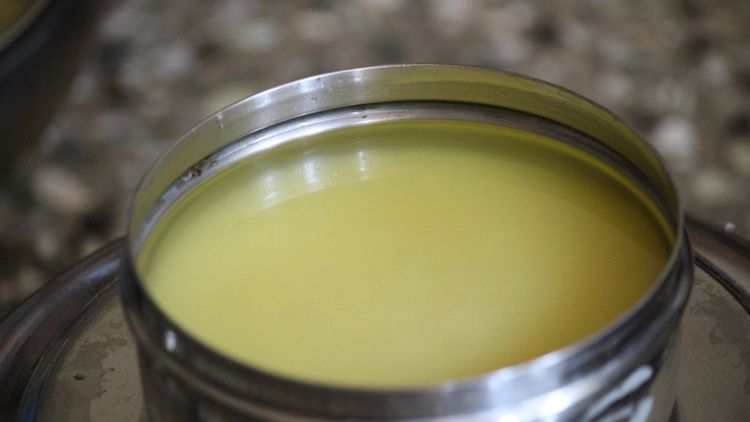
For ghee you keep the pan on the heat. The solids at the bottom take on colour, the kitchen smells nutty, and only then do you strain the golden fat through cloth or a fine sieve. That extra time is not a flourish. It is the step that turns plain butteroil into ghee. If you want a jar from the hob rather than the shop, use our homemade ghee method.
A wide pan helps the water leave evenly. Keep the heat moderate so the solids brown rather than burn — burnt solids make bitter ghee that straining will not hide.
When to use each
Use ghee when you want that toasted flavour in the dish itself: tempering whole spices (tadka), finishing dal, cooking khichdi, spooning over rice or flatbreads, or searing when a nutty note is welcome. Indian recipes on this site are written for ghee for that reason, not because clarified butter would refuse the heat.
Use clarified butter when you want butter’s richness without its water, and without ghee’s caramelised taste. Classic French emulsion sauces are the usual example. It is also the quieter choice for eggs, fish or vegetables where you do not want the fat to announce itself.
Either fat will handle a hot pan better than ordinary butter. USDA FoodData Central lists salted butter (FDC 173410) at about 16.2 g water and 81.1 g fat per 100 g. The same database’s anhydrous butter oil (FDC 173412) is 0.24 g water and 99.48 g fat per 100 g. That missing water, and the missing solids, are why a spoonful of ghee or clarified butter does not spit and brown the way a pat of butter does in a ripping-hot pan. For ghee next to olive oil or tallow, see ghee vs olive oil and tallow vs ghee.
How to read the label
In many US shops the two names are printed together. 4th & Heart’s original jar, for example, is listed as “Ghee, Clarified Butter.” That is a retail habit, not a Codex ruling. If you want true ghee, look for a deep golden colour, a nutty smell when you open the jar, and an ingredients list that is simply butter (or cream) — or the word ghee itself. If the fat tastes flat and pale, you may have culinary clarified butter sold under a ghee name, which is still seed-oil-free and still useful; it just will not give a tadka the same aroma.
Skip anything that adds vegetable oils, “spreads” or margarine blends. Our pantry is butter, ghee, tallow, lard, coconut oil and olive oil, with cold-pressed sesame only in small amounts as a finishing flavour. Both proper ghee and proper clarified butter belong in that list. Neither is a seed oil.
Can you swap them?
Yes, by weight or by spoon, in almost any savoury recipe. The heat performance is similar. What changes is flavour. Substituting clarified butter in an Indian dish will not ruin it, but you will miss the toasted note that cooks in the region built the recipe around. Substituting ghee in hollandaise will work, and the sauce will taste more like browned butter than like plain butterfat — pleasant, just different.
In baking, both are nearly water-free, so they do not behave exactly like a block of butter (roughly one-sixth water). For butter-based cakes or pastry, see ghee vs butter. Between ghee and clarified butter themselves, a 1:1 swap is the usual starting point.
What USDA actually measures
FoodData Central does not publish separate SR Legacy entries titled “ghee” and “clarified butter.” The matching record is Butter oil, anhydrous (FDC 173412). Per 100 g it lists 876 kcal, 99.48 g fat (about 61.9 g saturated, 28.7 g monounsaturated and 3.69 g polyunsaturated, including about 2.25 g linoleic acid as 18:2), 0.28 g protein, 0.24 g water and 256 mg cholesterol. One tablespoon is listed at 12.8 g. Those figures describe concentrated milkfat. They do not measure the flavour difference that Codex and the culinary method are about.
Because the milk solids are strained out, most of the lactose and casein that ride with those solids leave the jar as well. Trace amounts can remain, depending on how carefully the fat was filtered. This page is not dietary advice; if you avoid dairy for medical reasons, speak with a clinician and read the label of the jar in front of you.
Storage
With the water gone, both fats keep longer than fresh butter in a clean, sealed jar away from strong light. How long depends on how dry the batch is and how often a wet spoon goes into it. Refrigeration is not required for a well-made jar, but it does no harm. If the fat smells stale or metallic, throw it out. Strain homemade batches clean; crumbs left in the jar spoil first.
For the rest of the traditional-fat pantry, the traditional cooking fats guide is the hub that sits above this comparison.
This is cooking and ingredient guidance only. For personal dietary questions, speak with a qualified clinician.
Frequently asked questions
Is ghee the same as clarified butter?
No. Ghee is a type of clarified butter, but it is cooked longer so the milk solids brown before they are strained out. That extra simmer gives ghee its nutty, caramelised flavour. Plain clarified butter stops once the water and milk solids have been separated, and tastes milder.
Can I substitute ghee for clarified butter 1:1?
Yes, in most savoury cooking. The heat performance is similar because both have had the milk solids removed. What changes is flavour: ghee is nuttier, clarified butter is quieter. In baking, neither behaves exactly like a block of ordinary butter, which still contains water.
Does ghee have a higher smoke point than clarified butter?
Published figures sit within a few degrees of each other. Wikipedia, citing Brown’s Understanding Food (2014), gives clarified butter about 252 °C / 486 °F. The same encyclopaedia, citing a British Columbia FoodSafe plan, gives ghee about 250 °C / 482 °F. Ordinary butter smokes much earlier because it still holds water and milk solids.
Why do some jars say “ghee, clarified butter”?
US retail listings often treat the names as synonyms. Codex STAN 280-1973 does not: it defines ghee separately as milkfat with an especially developed flavour and physical structure. If you want that toasted taste, open the jar — true ghee smells nutty.
Is clarified butter seed-oil-free?
Yes, when it is only butterfat. Both ghee and clarified butter are made from milk, cream or butter. Skip jars or spreads that add vegetable oils. They fit the same pantry as butter, tallow, lard, coconut oil and olive oil.
Where do the USDA numbers come from?
FoodData Central does not publish separate “ghee” and “clarified butter” entries in SR Legacy. The matching record is Butter oil, anhydrous (FDC 173412): per 100 g, 876 kcal, 99.48 g fat (about 61.9 g saturated, 28.7 g monounsaturated, 3.69 g polyunsaturated), 0.28 g protein and 0.24 g water. One tablespoon is listed at 12.8 g.
Sources
Part of: Traditional Cooking Fats Guide — Tallow, Ghee, Lard, Butter · Shop the pantry →
African, Hawaiian, Indian, Mediterranean, Asian, Exotic, Chicken, Rice, Cookies, Coffee, Spices, Plants, World Cuisine, 30-Minute Dinners and more.
View All Books on Amazon →