
As an Amazon Associate I earn from qualifying purchases. Affiliate disclosure.
Ghee and olive oil are the two fats most people keep next to the stove once they stop buying seed oils. One is an animal fat and one a fruit oil, so they behave differently in the pan and on the plate. This guide compares them with USDA data and published research, and it follows our tallow vs ghee comparison. Sources are at the end.
What ghee and olive oil are
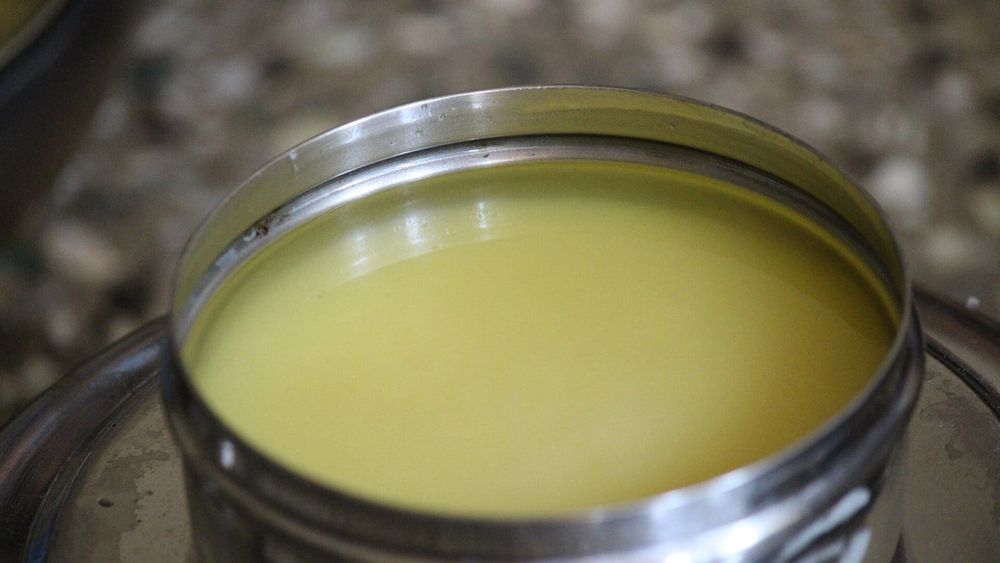
Ghee is made from milk, cream or butter. The Codex standard defines it as a product from which water and non-fat solids have been almost totally removed, with a minimum milkfat content of 99.6%.[5] See what is ghee and how to make ghee at home.
Olive oil is pressed from the fruit of the olive tree. It is not a seed oil; see is olive oil a seed oil?.
Ghee vs olive oil side by side
| Per 100 g | Ghee (USDA "butter oil, anhydrous") | Olive oil |
|---|---|---|
| Source | Milk fat (butter) | Olive fruit |
| Total fat | 99.5 g | 100 g |
| Saturated fat | 61.9 g | 13.8 g |
| Monounsaturated fat | 28.7 g | 73.0 g |
| Polyunsaturated fat | 3.7 g | 10.5 g |
| Linoleic acid (18:2) | 2.3 g | 9.8 g |
| Cholesterol | 256 mg | 0 mg |
| Vitamin A (RAE) | 840 µg | 0 µg |
| Vitamin E | 2.8 mg | 14.4 mg |
| Smoke point | 220–240 °C (428–464 °F), review table | about 207 °C (404 °F), extra virgin, heating study |
| At room temperature | Soft or grainy solid | Liquid |
| Dairy | Yes (milk solids almost totally removed) | No |
Nutrients: USDA FoodData Central SR Legacy, "Butter oil, anhydrous" (FDC 173412), USDA's closest entry for ghee, and "Oil, olive, salad or cooking" (FDC 171413).[1][2] Smoke points: Kumar and Jadhav, Frontiers in Food Science and Technology, 2026, for ghee;[3] De Alzaa et al. 2018 for extra virgin olive oil.[4]
Smoke point and high-heat cooking
On paper, ghee has more headroom. The 2026 Frontiers review lists ghee at 220–240 °C,[3] and a 2018 heating study measured extra virgin olive oil at about 207 °C.[4] The same review notes that normal cooking happens at about 180–200 °C,[3] so both are usable for sautéing and roasting at home. The 2018 study also found that smoke point alone did not predict how well an oil held up under heat: extra virgin olive oil produced fewer polar compounds than several oils with higher smoke points.[4] Read published smoke points as ranges, and turn the heat down if the pan is smoking. More in cooking fat smoke points.
Fat profile
These two sit at opposite ends. Ghee is mostly saturated fat (61.9 g per 100 g); olive oil is mostly monounsaturated (73.0 g).[1][2] Ghee carries vitamin A (840 µg RAE) and cholesterol (256 mg); olive oil has neither but more vitamin E (14.4 mg vs 2.8 mg).[1][2]
On linoleic acid, ghee is lower: 2.3 g per 100 g against 9.8 g for olive oil. Both are far below soybean oil at about 51 g, and in the same low range as beef tallow (3.1 g).[1][2][7][6] If you are managing saturated fat or cholesterol for a medical reason, follow your own doctor's or dietitian's advice.
This page contains affiliate links. As an Amazon Associate I earn from qualifying purchases. Affiliate disclosure.

Organic grass-fed ghee in a 14 oz jar. Use it for tadka, high-heat sautéing and anywhere you want butter flavour without burnt milk solids.
Check price on Amazon
A 1 litre bottle of organic extra virgin olive oil for dressings, finishing and everyday sautéing.
Check price on AmazonWhen to use ghee and when to use olive oil
Use ghee for
- Indian cooking: tadka, dal, biryani and parathas, where ghee is the traditional fat.[3] Try ghee butter chicken.
- High-heat sautéing where you want butter flavour.
- Eggs: ghee scrambled eggs.
Use olive oil for
- Dressings and dips: it stays liquid when cold. Try seed oil free hummus.
- Mediterranean dishes: ratatouille and Spanish tortilla.
- Finishing soups, grilled vegetables and bread.
- Dairy-free and plant-based cooking.
Dairy and diets
Ghee is still a dairy product: Codex defines water and non-fat solids as almost totally removed, not completely.[5] Anyone with a diagnosed milk allergy should treat ghee as dairy and check with their allergist. Olive oil is plant-based. If you want a dairy-free fat with ghee-like heat tolerance, see tallow vs ghee.
Buying
For ghee, look for a label that says just ghee or clarified butter. For olive oil, buy extra virgin in a dark bottle and check for blends with other oils. Our brand comparisons are in best ghee brands, and the full pantry list is on the shop page.
Frequently asked questions
Which has a higher smoke point, ghee or olive oil?
Ghee, on published figures. A 2026 Frontiers review lists ghee at 220–240 °C (428–464 °F). A 2018 heating study measured extra virgin olive oil at about 207 °C (404 °F). Home cooking mostly happens at 180–200 °C, below both.
Is ghee or olive oil better for frying?
Both can be used. Ghee has the higher published smoke point and is the traditional frying fat in Indian cooking. Extra virgin olive oil works well for sautéing and shallow frying.
Is olive oil a seed oil?
No. Olive oil is pressed from the olive fruit, not from seeds. It does contain more linoleic acid than ghee: about 9.8 g vs 2.3 g per 100 g (USDA).
Is ghee dairy-free?
No. Ghee is made from milk, cream or butter, with water and non-fat solids almost totally removed, not completely. Olive oil is plant-based and contains no dairy.
Can I swap ghee for olive oil?
In most cooking, 1:1. Both are almost pure fat. Ghee adds a buttery, nutty flavour; olive oil adds a fruity or peppery one. For salad dressings, use olive oil, since ghee sets solid when cool.
Sources
- USDA FoodData Central: Butter oil, anhydrous (FDC 173412)
- USDA FoodData Central: Oil, olive, salad or cooking (FDC 171413)
- Kumar & Jadhav, Understanding the techno-functionality of ghee as a cooking medium, Frontiers in Food Science and Technology, 2026
- De Alzaa, Guillaume & Ravetti, Evaluation of chemical and physical changes in different commercial oils during heating, Acta Scientific Nutritional Health (2018)
- Codex Alimentarius, Standard for Milkfat Products (CXS 280-1973)
- USDA FoodData Central: Fat, beef tallow (FDC 171400)
- USDA FoodData Central: Oil, soybean, salad or cooking (FDC 171411)
Part of: Traditional Cooking Fats Guide — Tallow, Ghee, Lard, Butter · Tallow vs Ghee · Shop the pantry →
African, Hawaiian, Indian, Mediterranean, Asian, Exotic, Chicken, Rice, Cookies, Coffee, Spices, Plants, World Cuisine, 30-Minute Dinners and more.
View All Books on Amazon →