Growing mushrooms at home is fundamentally different from growing vegetables — mushrooms are fungi, not plants, and their requirements are almost the opposite of most garden crops. No sunlight required. High humidity essential. The growing medium is not soil but a substrate of straw, woodchip, or spent coffee grounds. The process is straightforward once the logic of fungal biology is understood, and the result — fresh mushrooms harvested minutes before cooking — is a quality improvement over anything commercially available.
Mushroom Biology Basics
Mushrooms are the fruiting body of a fungal organism whose main body — the mycelium — grows invisibly through a substrate, breaking down organic material and absorbing nutrients. The mushroom emerges when the mycelium has colonised the substrate fully and environmental conditions (temperature, humidity, CO2 levels, light) trigger fruiting. Growing mushrooms at home means creating those conditions in a controlled way.
Easiest Varieties to Grow at Home
- Oyster mushrooms (Pleurotus ostreatus) — the most forgiving, fastest, and most widely grown. Colonises straw or cardboard quickly and fruits in 2-3 weeks.
- Shiitake (Lentinula edodes) — slower but rewarding. Grown on hardwood logs or sawdust blocks, fruits 6-12 months after inoculation.
- King oyster (Pleurotus eryngii) — dense, meaty texture, excellent flavour. Same requirements as oyster mushrooms.
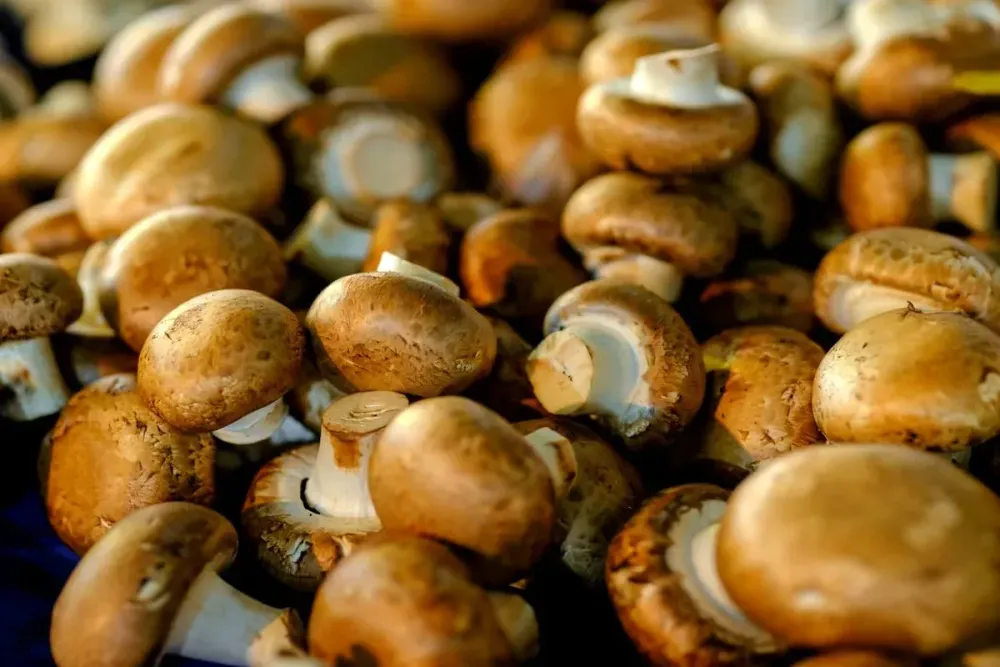
- Chestnut mushrooms (Agaricus bisporus var. brunescens) — the familiar supermarket variety. Requires a casing layer of peat or coir.
Growing Oyster Mushrooms on Straw — The Beginner Method
Ingredients
- Oyster mushroom grain spawn (available online)
- Wheat or oat straw (or cardboard as an alternative)
- Large zip-lock bags or a bucket with small holes
- Thermometer and spray bottle
Method
- Pasteurise the straw: soak in water at 65-75°C for 1 hour, or soak in a lime solution (1 tbsp hydrated lime per 5L water) for 12-18 hours. This kills competing organisms without sterilising.
- Allow to cool to below 30°C. Squeeze out excess water.
- Layer straw and grain spawn alternately in the bag or bucket. Roughly 1 part spawn to 5-10 parts straw by weight.
- Seal. Make small holes (5mm) around the bag or bucket for gas exchange.
- Incubate at 20-25°C in a dark location for 10-14 days until the substrate is fully white with mycelium.
- When fully colonised, move to a fruiting location: cooler (15-20°C), high humidity (85-95%), indirect light.
- Mist the holes 2-3 times daily to maintain humidity.
- Mushrooms will begin pinning (forming small clusters) within days. Harvest when caps begin to flatten before they curl upward.
In the MAHA Kitchen
Fresh oyster mushrooms sautéed in butter or ghee over high heat — they require a very hot pan to brown rather than steam — are one of the best simple preparations in the seed oil free kitchen. The browning of mushrooms in butter produces the same Maillard reaction as meat and is one of the most satisfying entirely plant-based MAHA dishes.
Where to buy mushroom spawn?
Online suppliers specialising in mycology equipment and supplies carry grain spawn in many varieties. Grocery store mushrooms cannot be used as spawn.
Why is my substrate not colonising?
Either the substrate was too hot when inoculated (killing the spawn), too wet, or was not pasteurised adequately and competing organisms took hold. Start fresh with properly pasteurised substrate and cooled before inoculation.
How many flushes does a bag produce?
3-5 flushes are typical for oyster mushrooms. Yield decreases with each flush. After the last productive flush, the spent substrate makes excellent garden compost.
📌 Follow on Pinterest: Grow Your Own Food on Pinterest
Follow Savannah: @theefoodiekitchen · Facebook · All Links
African, Hawaiian, Indian, Mediterranean, Asian, Exotic, Chicken, Rice, Cookies, Coffee, Spices, Plants, World Cuisine, 30-Minute Dinners and more.
View All 23 Books on Amazon →