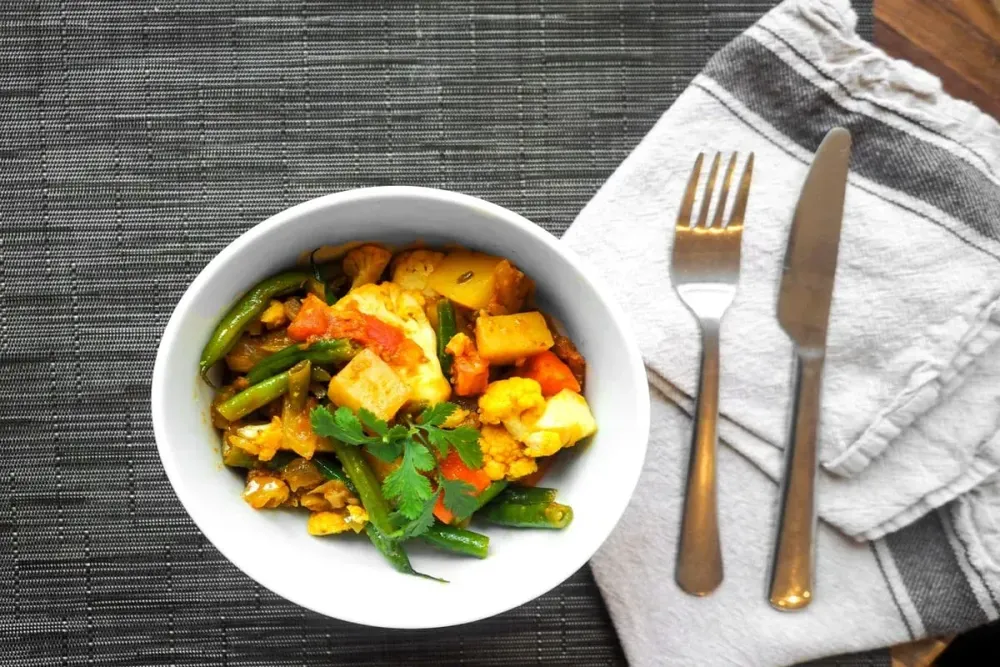
Aloo gobi is Punjabi home cooking at its most honest — potato and cauliflower cooked in ghee with turmeric, cumin seeds, ginger, and green chilli, covered and allowed to steam in their own moisture until completely tender. It is a dry-style curry (no sauce), which means the ghee carries the spices directly onto the surface of each piece of vegetable rather than diluting them in liquid. The result is a simple dish of considerable flavour from minimal ingredients.
Dry vs Wet Curry
Aloo gobi is a sukha sabzi — a dry vegetable dish — as opposed to a gravy-based curry. The absence of tomato sauce and the brief cooking time preserve the individual character of the potato and cauliflower rather than dissolving them into a uniform sauce. The dish works because the ghee-fried spices cling directly to the vegetables. This technique — dry-cooking vegetables in spiced ghee — is fundamental to Punjabi home cooking and produces a different, often more nuanced result than the sauced versions more familiar from restaurants.
Serves 4 · Prep 10 min · Cook 25 min
Ingredients
- 400g waxy potatoes, cubed 2cm
- 1 medium cauliflower, cut into florets
- 3 tbsp ghee
- 1 tsp cumin seeds
- 1/2 tsp mustard seeds
- 1 tsp turmeric
- 1 tsp coriander powder
- 1/2 tsp cumin powder
- 1/2 tsp chilli powder
- 2cm ginger, grated
- 2 green chillies, slit
- 1/2 tsp garam masala
- Fresh coriander, lemon, salt
Method
- Parboil potatoes 5 minutes. Drain well.
- Heat ghee in a wide pan over medium heat.
- Add cumin and mustard seeds. Wait for them to pop.
- Add ginger and green chilli. Cook 30 seconds.
- Add turmeric, coriander, cumin, chilli powders. Stir 30 seconds.
- Add potatoes. Toss to coat in spiced ghee.
- Add cauliflower. Mix well.
- Cover and cook 15 minutes on low heat, stirring once halfway.
- Remove lid. Cook 3 more minutes to dry any steam.
- Finish with garam masala, fresh coriander, and a squeeze of lemon.
Why parboil the potatoes first?
Raw potatoes and cauliflower have different cooking times. Parboiling brings the potatoes part-way to done so both vegetables are ready at the same moment.
Can I add tomato to aloo gobi?
Adding tomato creates a different dish — a sauced version that is perfectly good but not the traditional sukha style. For the dry version, no tomato.
How to prevent the cauliflower from going mushy?
Do not add any water. The covered pan creates steam from the vegetables themselves. Use medium-low heat and do not overcook.
Follow Savannah: @theefoodiekitchen · Facebook · All Links
Storage and Reheating
Store refrigerated for up to 3 days. Reheat in a dry pan over medium heat rather than the microwave — the microwave makes the potatoes watery and soft. In the pan, the potatoes regain their original slightly crispy edges in 4-5 minutes with the lid off.
Recipe Variations
- Restaurant dhaba style — increase the oil to 3 tablespoons, cook on high heat throughout rather than medium, and add a tablespoon of cream at the end — the north Indian highway dhaba version with a richer, glossier result
- Cauliflower-only version — omit the potato entirely and use a full large cauliflower cut into slightly larger florets — the cooking time reduces to 12 minutes total
- Adjust the fat — this recipe works equally well in ghee, lard, or grass-fed butter if ghee is unavailable. Each fat produces a slightly different flavour profile; ghee gives the most historically accurate result.
What to Serve With Aloo Gobi
Serve with roti, paratha, or naan. Aloo gobi is a dry dish — it has no sauce — and works well alongside a dal that provides the liquid component of the meal. A small side of yogurt with cumin (raita) and a green chutney balance the spiced potato and cauliflower. It is one of the most reliable dishes for a full Indian thali spread.
Why does restaurant aloo gobi taste different from home cooking?
Two reasons: heat and fat. Restaurant versions cook on extremely high heat (600°F+ in commercial tandoor-adjacent setups) that produces more Maillard browning on the edges of the vegetables. They also use more fat — typically 3-4 tablespoons versus the 1-2 tablespoons typical in home recipes. Cooking on the highest heat your stovetop allows and using more ghee closes most of the gap.
How do I prevent aloo gobi from becoming mushy?
Do not add water. The moisture in the cauliflower and potatoes is sufficient to steam-cook the vegetables with the lid on. Adding water produces mushy vegetables. If the dish seems dry before the vegetables are cooked, add only 1-2 tablespoons at most.
Can I use oil instead of ghee?
A neutral oil works mechanically but ghee is the correct fat — its flavour integrates with the spices in a way that neutral oil does not. The Maillard reaction also runs differently in ghee at high heat, producing more complex browning on the vegetable surfaces.
African, Hawaiian, Indian, Mediterranean, Asian, Exotic, Chicken, Rice, Cookies, Coffee, Spices, Plants, World Cuisine, 30-Minute Dinners and more.
View All 23 Books on Amazon →