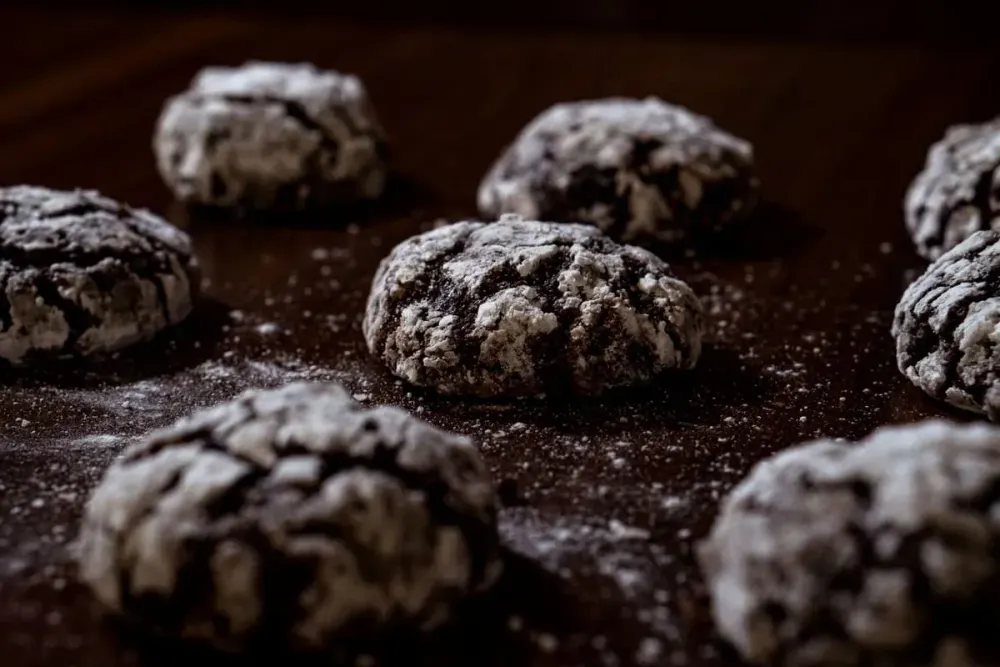
Chocolate crinkle cookies are built for drama. The powdered sugar coating cracks during baking to reveal a dark chocolate interior — the crinkle effect that gives them their name. The technique is specific: the dough must be cold, the cookies coated generously in powdered sugar (not a dusting), and the oven temperature must be right. All butter. No vegetable oil. The recipe is simple and unambiguous.
Why Crinkle Cookies Crinkle
The crinkle effect happens because the outside of the cookie sets faster than the inside. As the interior continues to expand from the leavening (bicarbonate of soda), it pushes through the set exterior, creating cracks. The powdered sugar coating, which sets quickly on contact with oven heat, enhances the visual contrast — white sugar against dark chocolate interior. Cookies that do not crinkle are either under-chilled (dough too soft, spreads instead of cracking) or overbaked (set completely before the cracks develop).
The Butter Technique
Unlike brown butter cookies, crinkle cookies use regular melted butter — the texture needs to be fudgy and dense, which melted butter produces better than creamed. The melted butter combined with sugar creates a slightly sticky dough that after chilling becomes firm enough to roll but still soft enough to produce the characteristic chewy-centred texture.
Makes 20 cookies · Prep 20 min + chill · Cook 10 min
Ingredients
- 150g unsalted butter, melted
- 400g caster sugar
- 4 large eggs
- 2 tsp vanilla extract
- 300g all-purpose flour
- 100g cocoa powder (Dutch process)
- 2 tsp bicarbonate of soda
- 1 tsp salt
- 150g powdered sugar for rolling
Method
- Whisk together melted butter, caster sugar, eggs, and vanilla until smooth.
- Sift in flour, cocoa, bicarbonate of soda, and salt. Mix until a soft dough forms.
- Cover and refrigerate at least 4 hours or overnight.
- Preheat oven to 180°C. Line baking trays with parchment.
- Scoop dough into 30g balls. Roll each ball generously in powdered sugar — they should be completely coated with no gaps.
- Place on prepared trays, spacing 5cm apart.
- Bake 10-11 minutes until crinkled on top and just set at the edges. The centres should still look slightly underdone.
- Cool on the tray for 5 minutes before transferring. They firm up significantly as they cool.
Dutch Process vs Natural Cocoa
Dutch process cocoa is alkalized, which neutralises its natural acidity, producing a darker colour and smoother, less bitter flavour. Natural cocoa is acidic and lighter in colour with a sharper, more complex flavour. Crinkle cookies are traditionally made with Dutch process for the dark visual drama and mellow flavour. If you only have natural cocoa, the cookies will still work but will be lighter in colour and slightly more bitter.
Why are my crinkle cookies not cracking?
Either the dough was not cold enough when it went in the oven, or the powdered sugar coating was too thin. Both cause the exterior to set gently without the dramatic cracking. Chill thoroughly and coat generously.
Can I freeze the dough?
Yes — roll into balls and coat in powdered sugar before freezing on a tray. Once frozen, transfer to a bag. Bake from frozen at 180°C, adding 3-4 minutes to the baking time.
How fudgy should the centre be?
Very. They should look underdone when you pull them from the oven. The centre sets to a dense, fudgy consistency as they cool — not raw, but not dry.
📌 Follow on Pinterest: Seed Oil Free Cookies & Sweets on Pinterest
Follow Savannah: @theefoodiekitchen · Facebook · All Links
African, Hawaiian, Indian, Mediterranean, Asian, Exotic, Chicken, Rice, Cookies, Coffee, Spices, Plants, World Cuisine, 30-Minute Dinners and more.
View All 23 Books on Amazon →