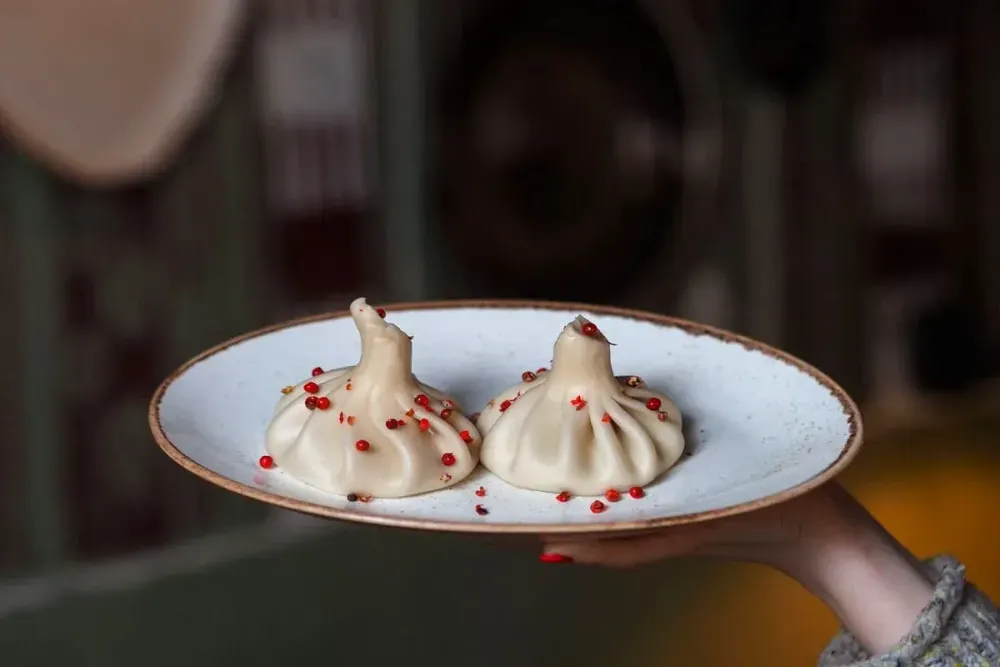
Khinkali are the national dumpling of Georgia — the South Caucasus country between Russia, Turkey, Armenia, and Azerbaijan. Each dumpling is a thick-walled pasta package containing a mixture of minced beef and pork with fresh herbs and natural broth, twisted into a pleated knot at the top. They are boiled and eaten by hand, holding the knot (which is not eaten) and biting a small hole in the top to drink the broth before eating the rest. The correct accompaniment is melted butter and black pepper.
The Filling and Its Juiciness
The filling of khinkali is deliberately soupy — minced meat combined with a large quantity of chopped onion, fresh herbs (coriander, parsley), and cold water or stock. The liquid is what creates the broth that fills the dumpling during boiling as the meat steams from the inside. The pleating at the top seals the broth in. When done correctly, biting into khinkali produces a rush of hot, intensely flavoured meat broth before the filling is reached.
The Dough
Khinkali dough is simple but requires attention to texture: plain flour, salt, and water, kneaded thoroughly until smooth and elastic, then rested for 30 minutes. The dough must be rolled thin enough to cook through but thick enough not to break during the boiling — approximately 3mm is standard. The traditional pleating involves 18-20 folds, though 12-15 is acceptable for home cooks.
Makes 20 · Prep 1 hour · Cook 12 min
Ingredients
- Dough: 400g plain flour, 180ml cold water, 1 tsp salt
- Filling: 400g mixed beef and pork mince, 1 large onion very finely diced, 4 tbsp fresh coriander chopped, 2 tbsp fresh parsley chopped, 100ml cold water or stock, 1 tsp cumin, salt and black pepper
- To serve: 50g melted butter, freshly cracked black pepper
Method
- Make dough: combine flour and salt. Add water gradually, kneading until smooth. Rest 30 minutes covered.
- Make filling: combine all filling ingredients. Mix well. The mixture should be quite wet and loose.
- Roll dough to 3mm. Cut circles 10-12cm diameter.
- Place 1 heaped tablespoon filling in the centre of each circle.
- Pleat the edges together around the filling, twisting to seal at the top.
- Boil in generously salted water 12-15 minutes until the dough is cooked through.
- Remove with a slotted spoon. Drizzle with melted butter and black pepper.
- Eat by hand — hold the knot, bite a small hole, drink the broth, then eat.
The Knot
The pleated knot at the top of each khinkali (called the kudi) is not eaten — it is the handle by which the dumpling is held. In Georgia, the number of kudi left on the plate at the end of a meal is sometimes counted as a measure of how many dumplings were eaten. The knots are too thick and doughy to eat pleasantly; leave them and feel no guilt.
Can I freeze khinkali?
Yes — freeze uncooked on a tray until solid, then transfer to bags. Cook from frozen in boiling water for 18-20 minutes.
What meat ratio is best?
70% beef, 30% pork is standard. The pork adds fat and moisture. 100% beef produces a drier, slightly less flavourful filling.
How do I prevent the dumplings from breaking?
Ensure the filling is well-sealed and the dough is rolled to an even thickness. Cook in gently boiling water — violent boiling can tear the wrappers.
📌 Follow on Pinterest: Exotic Global Recipes on Pinterest
Follow Savannah: @theefoodiekitchen · Facebook · All Links
African, Hawaiian, Indian, Mediterranean, Asian, Exotic, Chicken, Rice, Cookies, Coffee, Spices, Plants, World Cuisine, 30-Minute Dinners and more.
View All 23 Books on Amazon →