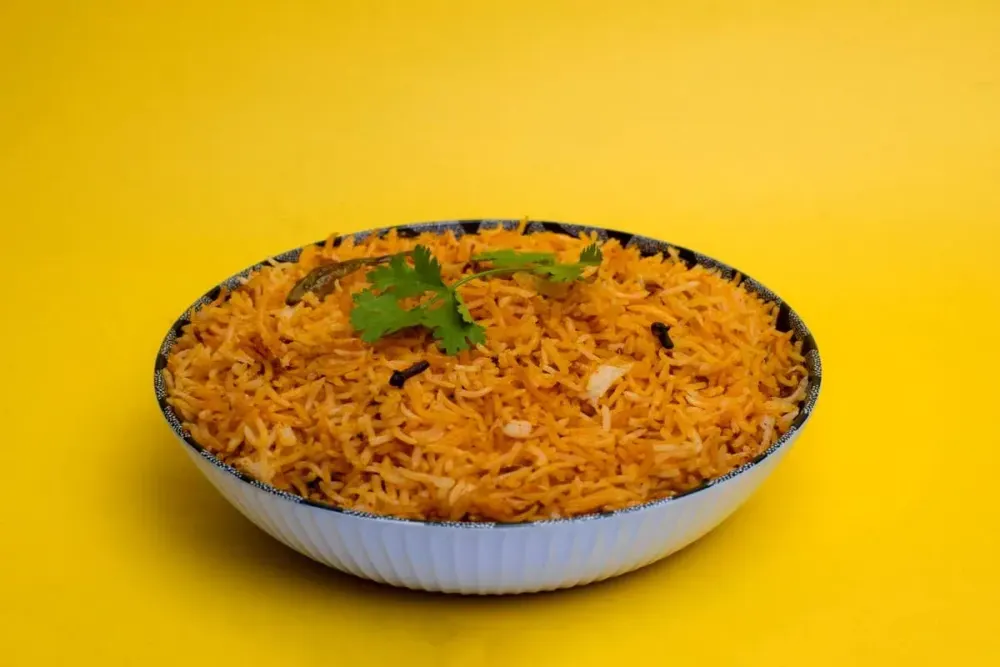
Saffron pilaf is the rice that appears alongside lamb kleftiko on the Greek island table, alongside Persian stews, alongside Moroccan tagine. Each culture has a version. The common thread is butter as the cooking fat and saffron for colour and fragrance. The pilaf method — toasting the dry rice in butter before adding hot stock — produces grains that are separate, flavourful, and lightly golden, not the sticky, steamed result of absorption cooking.
The Pilaf Method
The pilaf method: soften onion in butter, add raw dry rice, stir to coat each grain in butter, add hot stock, bring to boil, cover, cook on lowest heat until absorbed. The butter coating on each grain during the initial toast prevents the starch on the grain's surface from gelatinising immediately when stock is added — which is what keeps pilaf grains separate rather than clumping into risotto.
Serves 4 · Prep 5 min · Cook 25 min
Ingredients
- 300g basmati or long-grain rice
- 50g unsalted butter
- 1 onion, finely diced
- 600ml hot chicken or vegetable stock
- Large pinch saffron, bloomed in 3 tbsp hot water
- Salt, fresh parsley
Method
- Melt butter in a wide pan over medium heat.
- Cook onion gently 8 minutes until soft but not coloured.
- Add dry rice. Stir to coat each grain in butter. Toast 2 minutes.
- Add hot stock. Season. Bring to boil.
- Reduce to lowest heat. Cover tightly. Cook 15 minutes.
- Remove from heat. Stir saffron water through the rice.
- Cover again and rest 5 minutes.
- Fluff with a fork. Scatter parsley. Serve.
Why add saffron at the end?
Saffron's volatile aromatic compounds are heat-sensitive. Adding at the end preserves more of the floral character. Adding at the start still adds colour but less of the fragrance.
Can I use olive oil instead of butter?
Yes — olive oil pilaf is common across the Eastern Mediterranean. The flavour is lighter and more herbaceous. Butter produces a richer result.
What to serve saffron pilaf with?
Greek lamb kleftiko, Persian khoresh, Moroccan lamb tagine, or grilled chicken. It is the neutral-but-fragrant rice that works alongside any braised meat.
Follow Savannah: @theefoodiekitchen · Facebook · All Links
Storage and Reheating
Store covered at room temperature for up to 4 hours, or refrigerate for up to 3 days. Reheat covered with 1 tablespoon of water over the lowest possible heat for 8-10 minutes. The rice revives well without drying if reheated slowly with added moisture.
Recipe Variations
- Persian tahdig variation — after par-boiling the rice, line the base of the pot with butter and a thin layer of rice; pile the rest on top in a mound, wrap the lid in a clean cloth, and cook on the lowest heat for 30-40 minutes — the bottom forms a golden crust
- Add-in variation — stir in toasted pine nuts, dried barberries (zereshk), and a pinch of cinnamon for a Persian jewelled rice
- Adjust the fat — this recipe works equally well in ghee, lard, or grass-fed butter if grass-fed butter is unavailable. Each fat produces a slightly different flavour profile; grass-fed butter gives the most historically accurate result.
What to Serve With Saffron Pilaf
Saffron pilaf is the correct accompaniment for braised lamb, Persian stews (khoresh), grilled fish, and roasted chicken. In Persian and Middle Eastern tradition it is served with tahdig — the crispy rice crust that forms at the bottom of the pot — as the prize portion. A spoonful of the golden saffron butter poured on top at the table is the finishing touch.
How much saffron should I use in pilaf?
A large pinch — approximately 1/4 teaspoon of loosely packed threads — steeped in 3 tablespoons of hot water for 15 minutes before adding to the rice. More saffron produces an increasingly medicinal, bitter note.
Why bloom saffron in hot water?
Saffron's colour and flavour compounds (crocin and safranal) are water-soluble and extract more completely in warm liquid than when added directly to fat or dry rice. Steeping produces a uniformly golden colour throughout the dish.
Can I substitute butter with ghee in this pilaf?
Yes. Ghee produces a slightly nuttier, more fragrant result because of the Maillard reaction during clarification. The ratio is 1:1 — use the same quantity of ghee as butter.
African, Hawaiian, Indian, Mediterranean, Asian, Exotic, Chicken, Rice, Cookies, Coffee, Spices, Plants, World Cuisine, 30-Minute Dinners and more.
View All 23 Books on Amazon →