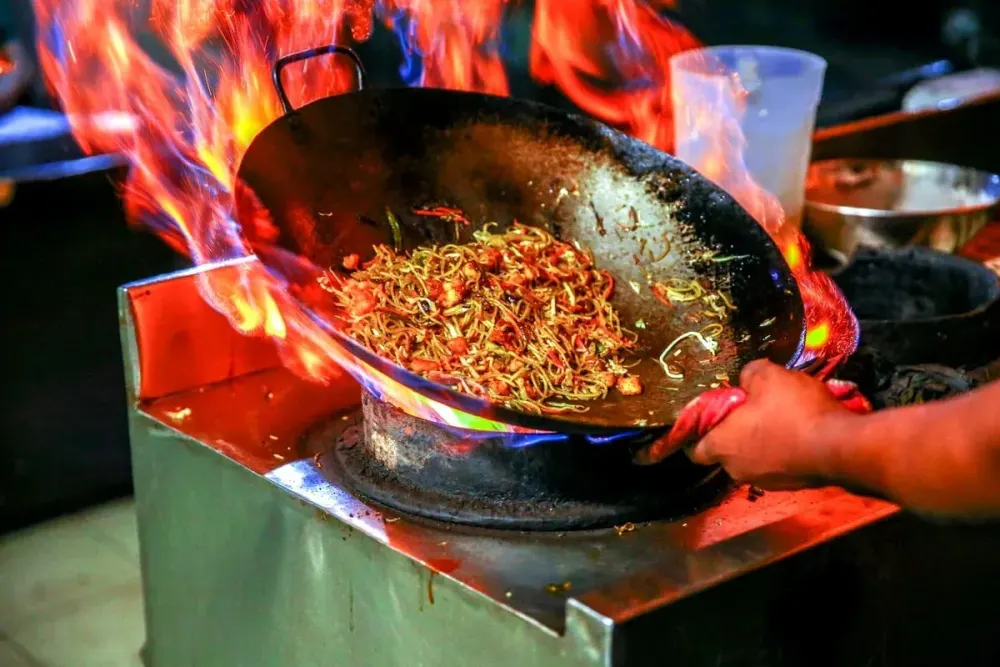
Pad see ew — 'fried with soy sauce' in Thai — is the flat rice noodle stir-fry that rivals pad thai as Thailand's most popular exported noodle dish. Wide sen yai noodles, fresh or dried, are tossed in a very hot wok with Chinese broccoli (gai lan), egg, and a sauce of dark and light soy sauce. The dish requires the highest achievable heat — the noodles must char slightly at the edges, the egg must set instantly, the greens must stay bright. Lard, with its high smoke point and clean fat profile, is the correct fat for achieving this at a domestic hob.
Sen Yai Noodles
Sen yai are wide, flat rice noodles approximately 2cm across. Fresh sen yai — which have a supple, slightly slippery texture — are available at Asian grocery stores and produce the best pad see ew. Dried wide rice noodles, soaked in cold water for 30 minutes before cooking, are the accessible substitute. Regular rice noodles or even linguine will work in an emergency but produce a different texture.
Dark vs Light Soy Sauce
The dual soy sauce system is important to pad see ew. Dark soy sauce (see ew dam) provides the deep brown colour, sweetness, and slight caramel note that characterises the dish. Light soy sauce provides salt and additional umami. Using only one or the other produces an imbalanced result. The ratio is approximately 1:2 dark to light for pad see ew's characteristic dark, glossy appearance.
Serves 2 · Prep 15 min · Cook 8 min
Ingredients
- 300g fresh wide rice noodles (or 200g dried, soaked)
- 2 tbsp lard
- 2 eggs, beaten
- 150g Chinese broccoli (gai lan) or broccolini, roughly chopped
- 150g protein — chicken, beef, tofu, or prawns
- 2 tbsp dark soy sauce
- 1 tbsp light soy sauce
- 1 tbsp oyster sauce
- 1 tsp sugar
- White pepper
Method
- If using fresh noodles, separate them gently. If using soaked dried, drain well.
- Mix sauce: dark soy, light soy, oyster sauce, sugar.
- Heat wok or cast iron pan over highest heat until smoking. Add lard.
- Add protein. Stir-fry 2 minutes until cooked. Push to sides.
- Add noodles. Spread and press — do not stir immediately. Let the bottom char slightly for 1 minute.
- Push noodles aside. Add egg to the centre. Scramble briefly, then toss through.
- Add gai lan. Toss everything together.
- Add sauce. Toss vigorously for 1-2 minutes.
- Season with white pepper. Serve immediately.
The Noodle Char
The slight char on the noodle edges — achieved by pressing the noodles flat on the hot pan surface and leaving them alone for 60-90 seconds — is the defining quality of great pad see ew. This caramelisation of the rice starch and dark soy sauce creates a complex, slightly bitter, smoky note that elevates the dish beyond a simple stir-fry. Do not stir too early. Let the char develop.
What is gai lan?
Chinese broccoli — a leafy green brassica with thick stems and small florets, slightly more bitter than Western broccoli. Regular broccoli, broccolini, or bok choy are good substitutes.
Can I use a non-stick pan instead of a wok?
A heavy cast iron pan is better than non-stick for this dish — it retains heat better. Non-stick pans should not be heated to the temperatures required for proper pad see ew.
Why lard instead of vegetable oil?
Lard produces wok hei — the characteristic smoky quality of high-heat wok cooking — more effectively than vegetable oil at domestic hob temperatures. Vegetable oil at high heat produces more acrolein and off-flavours; lard breaks down cleanly.
Follow Savannah: @theefoodiekitchen · Facebook · All Links
African, Hawaiian, Indian, Mediterranean, Asian, Exotic, Chicken, Rice, Cookies, Coffee, Spices, Plants, World Cuisine, 30-Minute Dinners and more.
View All 23 Books on Amazon →