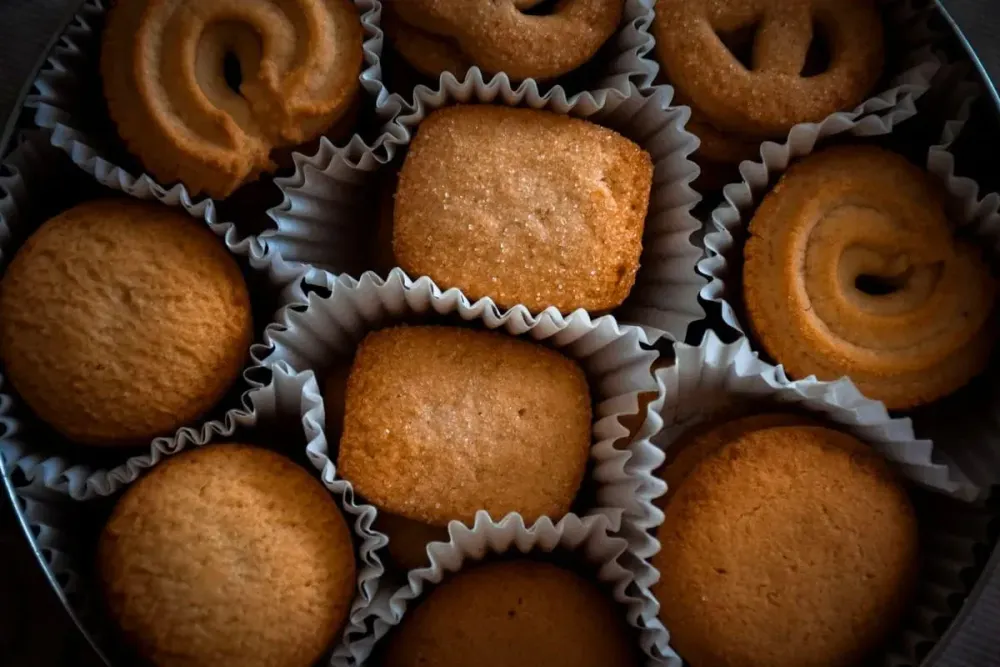
Japanese butter cookies — sometimes sold as 'Danish butter cookies' — are one of the most consumed biscuits in Japan, sold in tins from Hokkaido dairy brands and found in every convenience store and airport. What makes them distinct from Western butter biscuits is the ratio: more butter relative to flour, producing a biscuit that melts almost immediately when it hits the mouth rather than requiring chewing. This is achieved partly through the higher butter content and partly through the piping technique — piped through a star nozzle, the biscuit has a larger surface-area-to-volume ratio that bakes more evenly.
The Piping Technique
Japanese butter cookies are piped through a star nozzle (1M or 1B in Wilton sizing) onto the baking sheet. The piping creates a ribbed surface that increases the crispy surface area and produces the distinctive rosette or spiral shape. The dough must be soft enough to pipe but cold enough to hold its shape in the oven — the piped dough should be refrigerated for 15 minutes before baking.
Makes 30 · Prep 20 min · Chill 15 min · Bake 12 min
Ingredients
- 200g unsalted butter, very soft (room temperature for 2 hours)
- 100g icing sugar, sifted
- 2 egg yolks
- 1 tsp vanilla extract
- 200g plain flour, sifted
- 2 tbsp cornstarch (this contributes to the melt-in-the-mouth texture)
Method
- Beat very soft butter and sifted icing sugar until pale and extremely fluffy, 5 minutes.
- Add egg yolks and vanilla. Beat until combined.
- Add sifted flour and cornstarch. Fold until just combined.
- Transfer dough to a piping bag fitted with a star nozzle.
- Pipe rosettes or spirals onto lined baking sheets.
- Refrigerate 15 minutes.
- Preheat oven to 170°C. Bake 11-13 minutes until edges are just golden.
- Cool completely on the tray — they are fragile when hot.
Hokkaido Butter
The finest Japanese butter cookies use Hokkaido butter — from the northern island of Japan, where temperate pastures produce dairy of exceptional quality. Hokkaido butter has a higher fat content (84-86%) and a more pronounced dairy richness than standard butter. European-style butters (84% fat) such as Kerrygold or Lurpak are the closest widely available equivalent.
Why is the butter so soft?
The butter must be truly room temperature — soft enough to beat into a light, airy cream with the sugar. Cold butter will not aerate properly and the cookies will be dense.
Can I use a cookie press instead of piping bag?
Yes — a cookie press with a disc attachment works well. The effect is similar to a piping bag with a flat disc nozzle.
Why cornstarch?
Cornstarch dilutes the gluten-forming protein in the flour. Less gluten means a more tender, melt-in-the-mouth texture. This is the same principle behind shortbread's use of cornflour.
Related guides: Vegetable Oil Substitute Guide
📌 Follow on Pinterest: Seed Oil Free Cookies & Sweets on Pinterest
Follow Savannah: @theefoodiekitchen · Facebook · All Links
African, Hawaiian, Indian, Mediterranean, Asian, Exotic, Chicken, Rice, Cookies, Coffee, Spices, Plants, World Cuisine, 30-Minute Dinners and more.
View All 23 Books on Amazon →